
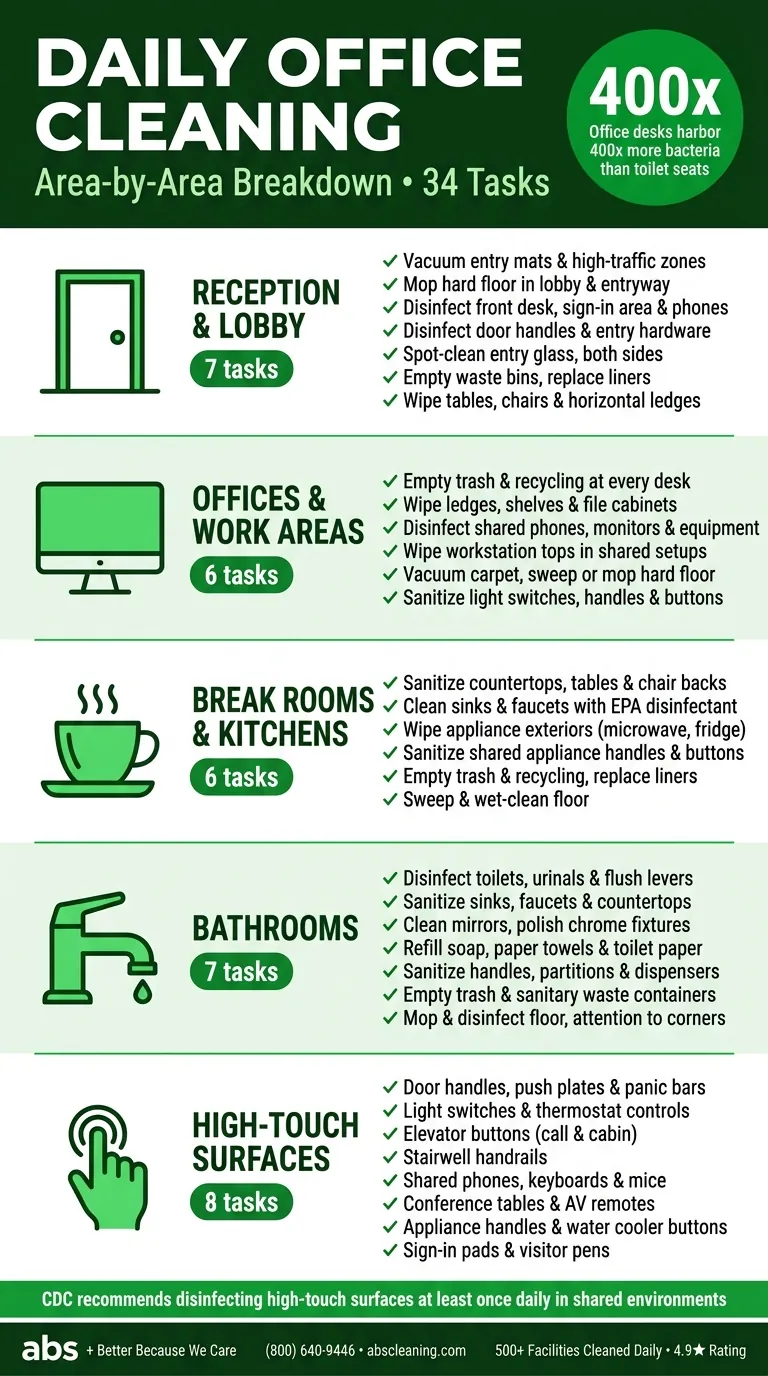
Office desks harbor roughly 400 times more bacteria than toilet seats, according to University of Arizona research. Keyboards and phones rank among the dirtiest items in any commercial building.
A structured cleaning checklist assigns every task to a frequency so nothing gets missed and nothing gets duplicated.
Key Takeaways
- Office work areas can harbor 400 times more bacteria than toilet seats.
- Daily tasks cover bathrooms, high-touch areas, trash removal, and sweeping or mopping.
- Weekly duties prevent grime buildup on baseboards, vents, glass partitions, and appliance interiors.
- Monthly maintenance extends the life of tile, VCT, and upholstery.
- Quarterly projects include stripping and waxing, exterior window cleaning, and exterior washing.
- A customized checklist should match your facility type, foot traffic, and compliance requirements.
Why Your Office Needs a Cleaning Checklist
A cleaning checklist reduces sick days, boosts productivity, and extends the useful life of your surfaces and furniture. OSHA emphasizes workplace hygiene as part of occupational safety standards, and research published by Harvard Business Review links organized work environments to improved focus and lower stress.
Without a written guide, routine cleaning tasks get skipped. The pattern is predictable: bathrooms receive daily attention, but baseboards, HVAC vents, and appliance interiors go weeks without care. Buildup accumulates. What could have been a weekly wipe-down turns into a recovery project that costs more and takes longer.
A structured checklist also creates accountability. When your office cleaning team knows exactly what to do, when to do it, and how to verify completion, cleanliness stays consistent across shifts and across locations.
That consistency is what separates a reliable commercial cleaning service from a cleaning provider that delivers unpredictable results.
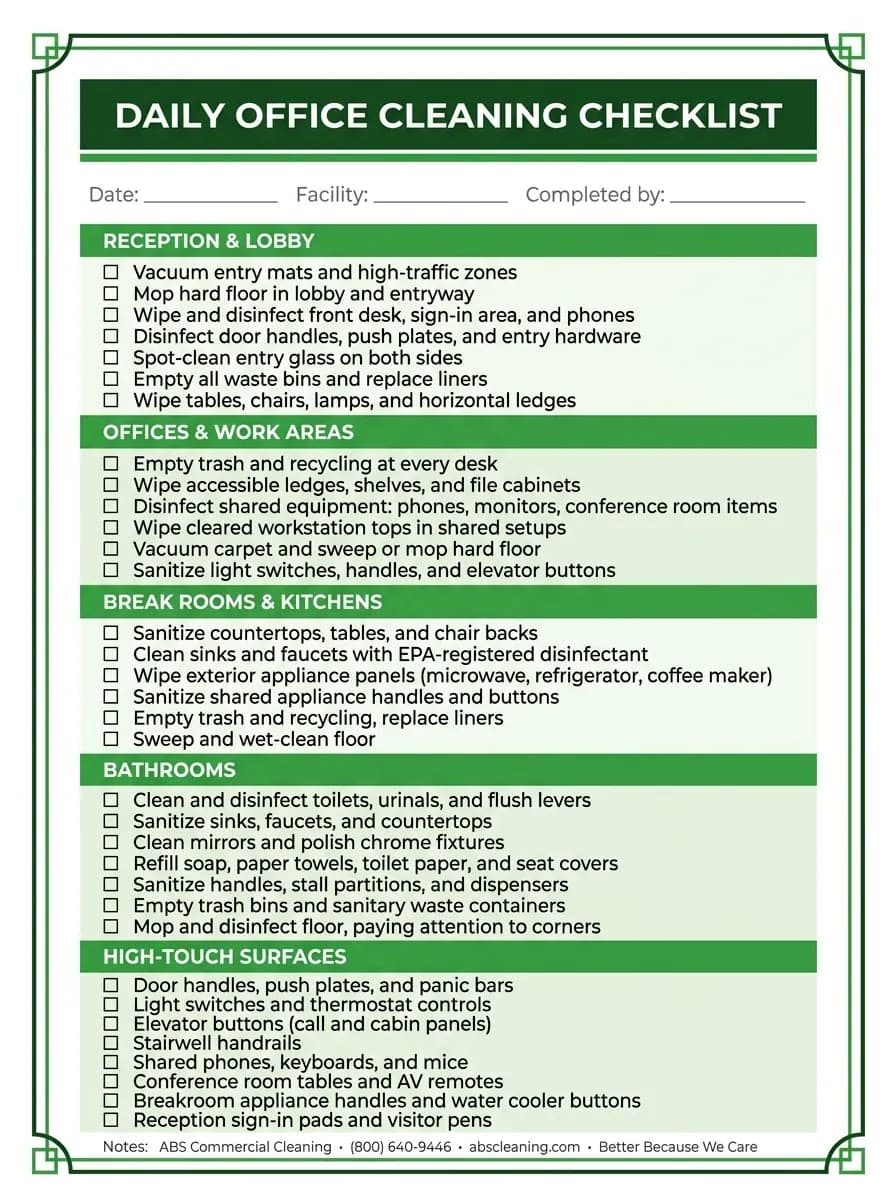
Printable Daily Office Cleaning Checklist
Daily Cleaning Checklist by Area
Daily cleaning focuses on high-traffic areas, shared items, and anything visitors or staff see within the first 30 seconds of entering your office building. These items should be completed after hours to avoid disrupting operations.
Reception & Lobby
Your reception area shapes every visitor's first positive impression. Stained tile or overflowing trash in the lobby reflects on your entire operation.
- Vacuum entry mats and busy zones
- Mop hard floor in the lobby and entryway
- Wipe and disinfect the front desk, sign-in area, and phones
- Disinfect door handles, push plates, and entry hardware
- Spot-clean entry glass on both sides
- Empty all waste bins and replace liners
- Wipe tables, chairs, lamps, and horizontal ledges
Offices & Work Areas
Drinking fountains, baseboards, and the tops of cubicle walls are commonly overlooked. Add them to your checklist to prevent buildup between deeper cleanings.
- Empty trash and recycling at every desk
- Wipe accessible ledges, shelves, and file cabinets
- Disinfect shared equipment: phones, monitors, and conference room items
- Wipe cleared workstation tops in shared setups
- Vacuum carpet and sweep or mop hard floor
- Sanitize light switches, handles, and elevator buttons
Break Rooms & Kitchens
Shared spaces like break rooms need extra attention. A spill left unattended attracts pests and creates odor problems in adjacent areas.
- Sanitize countertops, tables, and chair backs
- Clean sinks and faucets with an EPA-registered disinfectant
- Wipe exterior appliance panels (microwave, refrigerator, coffee maker)
- Sanitize shared appliance handles and buttons
- Empty trash and recycling, replace liners
- Sweep and wet-clean floor
Bathrooms
A hygienic bathroom signals that your business cares about the people inside it. Our restroom cleaning crews follow a similar process for every facility we serve.
- Clean and disinfect toilets, urinals, and flush levers
- Sanitize sinks, faucets, and countertops
- Clean mirrors and polish chrome fixtures
- Refill soap, paper towels, toilet paper, and seat covers
- Sanitize handles, stall partitions, and dispensers
- Empty trash bins and sanitary waste containers
- Mop and disinfect floor, paying attention to corners
High-Touch Areas to Disinfect Every Day
The CDC recommends disinfecting high-touch surfaces in shared environments at least once per day, and more often in high-risk settings. These spots collect germ-carrying bacteria because dozens or hundreds of people contact them every shift.
Your daily disinfection list should include:
- Entry and interior door handles, push plates, and panic bars
- Light switches and thermostat controls
- Elevator buttons (call panels and cabin panels)
- Stairwell handrails
- Shared work areas and hot-desking stations
- Phones, mice, and shared keyboards in open offices
- Conference room table centers and AV remotes
- Breakroom appliance handles and buttons
- Water cooler dispensers and vending machine buttons
- Restroom faucets, soap dispensers, and stall hardware
- Reception sign-in pads and visitor pens
Weekly Cleaning Checklist
Weekly cleaning addresses areas where grime builds gradually. Handling them on a consistent schedule prevents the kind of buildup that demands expensive recovery work later.
Surfaces and dusting:
- Detail vacuum along edges, corners, and under accessible furniture
- Mop all floor areas with a disinfectant suited to the material
- Spot-treat stains on textile surfaces before they set
- Wipe baseboards, door frames, vent covers, and ledges above arm's reach
- Sweep and wet-mop stairwells and service corridors
Glass, partitions, and hardware:
- Clean interior glass partitions and conference room walls
- Wipe interior windows and sills
- Polish metal frames, kick plates, and entry hardware
Appliance interiors:
- Clean inside microwaves, including turntable and vents
- Wipe refrigerator shelves and interiors
- Descale coffee makers per manufacturer guidance
Restroom detail work:
- Scrub tile grout lines to prevent mold and mildew
- Clean tile walls and stall partitions top to bottom
- Sanitize waste bins inside and out
Monthly Deep Clean Checklist
Monthly deep cleaning protects your building's long-term assets. Surfaces, upholstery, and HVAC components all degrade without scheduled maintenance. Recovering from neglect costs significantly more than prevention.
Textile and hard surface care:
Professional extraction every one to three months extends the life of fiber surfaces and maintains indoor air quality. High-traffic lobbies often need monthly extraction, while private offices can go quarterly. The IICRC S100 Standard provides the industry benchmark for textile floor covering care.
Vinyl composite tile (VCT) and other hard tiles benefit from monthly machine scrubbing, with stripping and waxing scheduled quarterly or semi-annually depending on traffic volume.
High dusting and air quality:
Accumulated particles on high shelves, light fixtures, ceiling corners, and ventilation grilles degrade indoor air and increase allergen load. Monthly high dusting with extension tools keeps these areas from feeding contaminants back into occupied spaces.
Fabric chairs, sofas, and partitions should be vacuumed monthly with HEPA equipment. Schedule professional cleaning for upholstery quarterly.
Interior windows and supply audits:
Full-detail interior window cleaning on a monthly basis preserves daylight quality. Pair this with a monthly supply audit: restock janitorial closets, check vacuum belts and filter cartridges, and verify dilution ratios.
Quarterly & Annual Tasks
| Task | Typical Frequency |
|---|---|
| Textile extraction (low-traffic areas) | Quarterly |
| Stripping and waxing | Quarterly to semi-annually |
| Exterior window cleaning | Quarterly |
| Pressure washing (sidewalks, parking lots, building exterior) | Quarterly |
| Tile and grout restoration | Quarterly |
| HVAC duct cleaning | Annually |
| Kitchen hood and exhaust cleaning (NFPA 96 standard) | Monthly to annually, based on cooking volume |
Stripping and waxing schedules depend on traffic patterns and the type of hard surface in your building. Texas heat and humidity can accelerate buildup on exterior areas, making quarterly exterior care a practical baseline.
How to Customize Your Checklist by Facility Type
The checklist above covers general office environments, where regular cleaning follows a standard office cleaning routine. Every industry layers additional requirements on top.
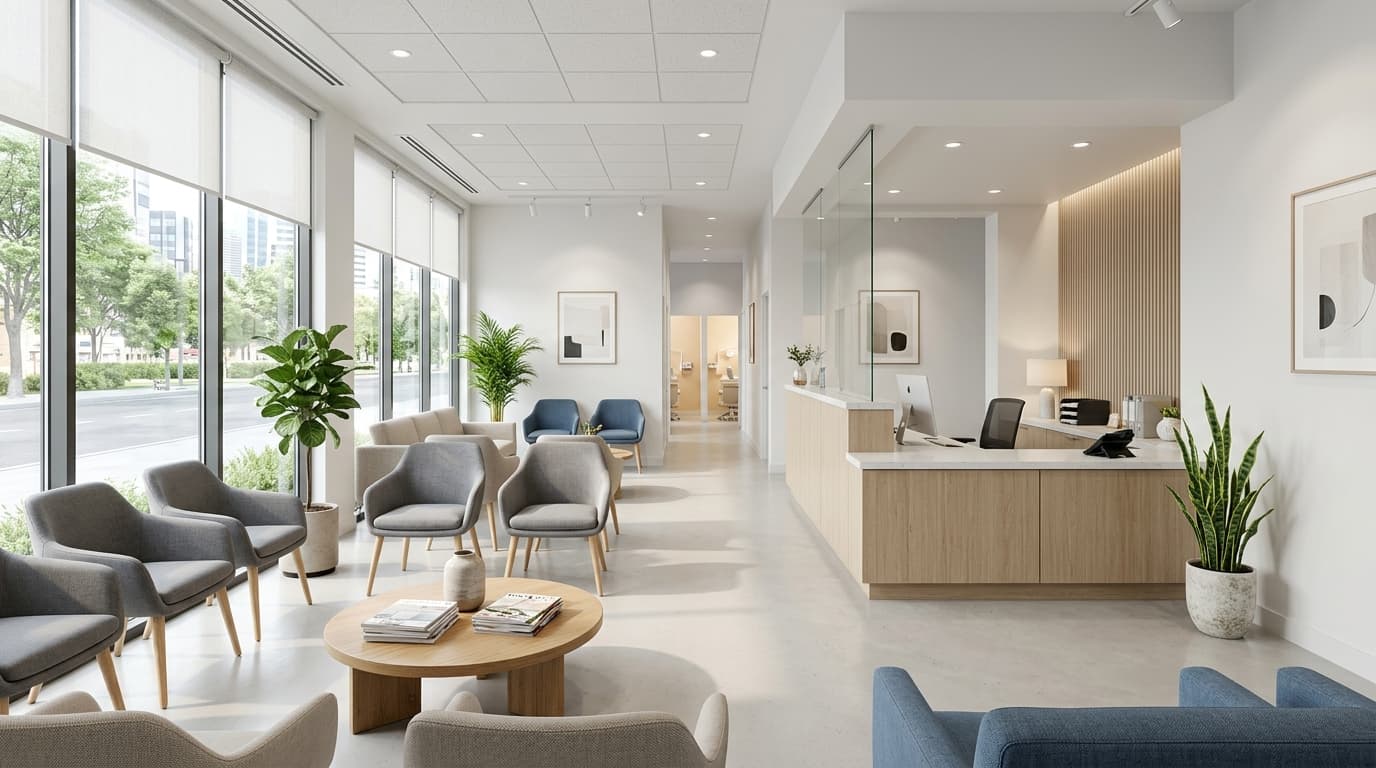
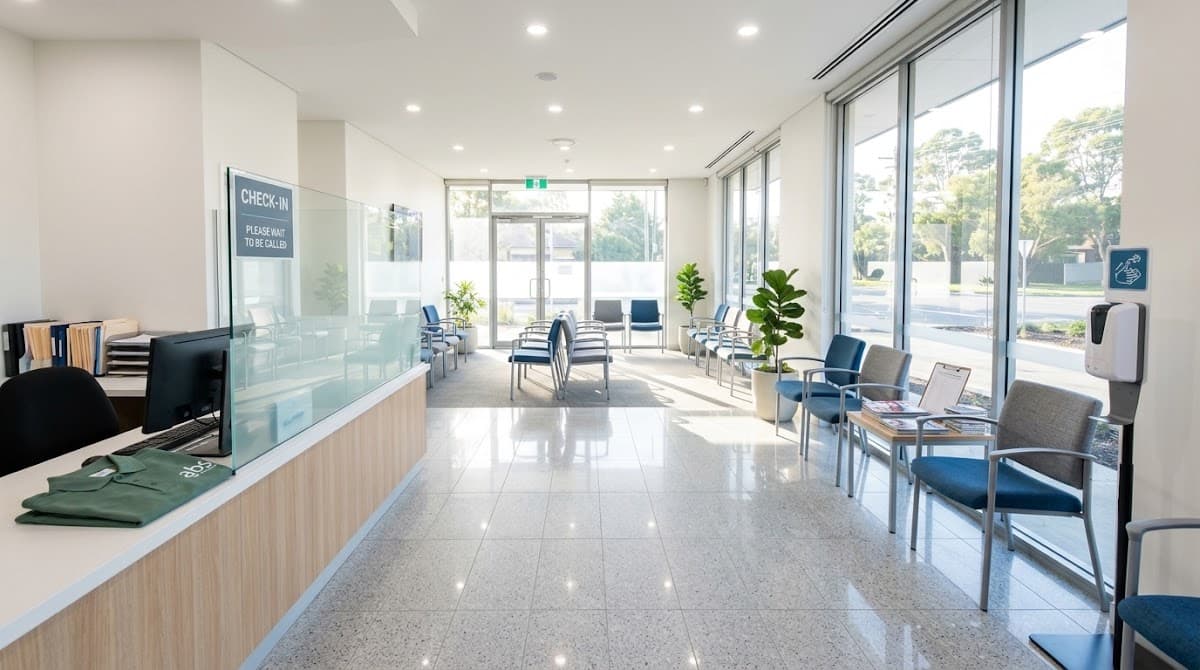
Medical offices and clinics require OSHA-compliant protocols, terminal cleaning procedures, and EPA-registered disinfectants that meet healthcare-grade standards. If your medical facility handles patient care, your checklist needs to account for biohazard handling and infection control.
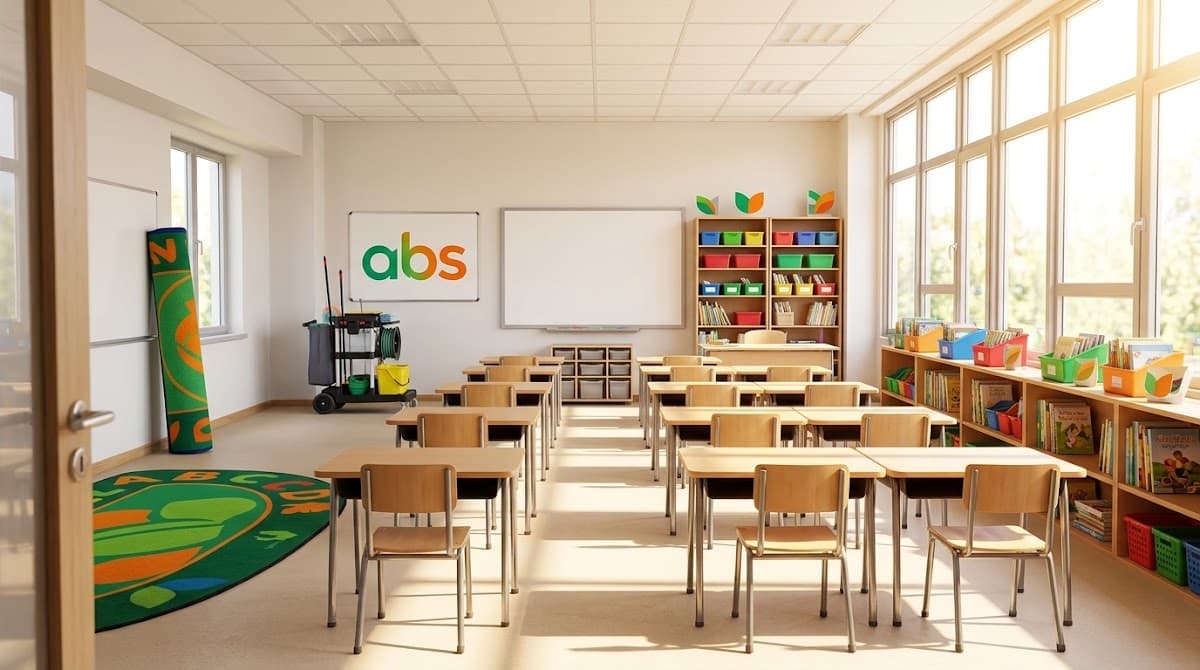
Schools and charter schools add child safety considerations, after-hours scheduling, and higher-frequency cleaning for classrooms, cafeterias, and gymnasiums. A school cleaning schedule should address bathroom sanitation multiple times per day during school hours.
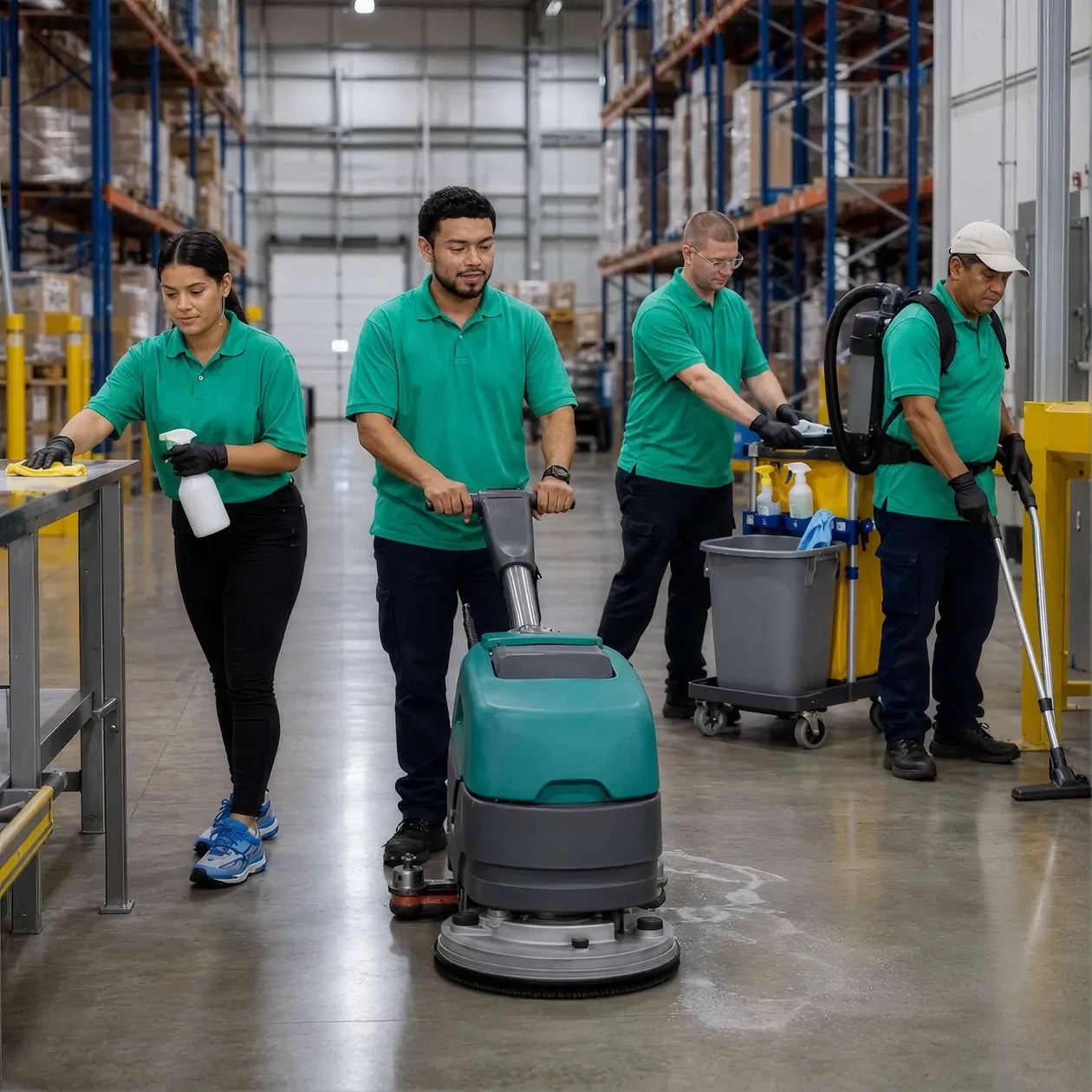
Industrial and warehouse spaces bring OSHA workplace standards, slip-resistance testing, and equipment-safe cleaning products into the mix.
Restaurants and food service facilities follow NFPA 96 for kitchen hood cleaning and FDA food-contact standards, with grease management as a daily priority.
Customize your plan to match the work your facility does, the daily volume it handles, and the compliance standards it must meet. A 2,000-square-foot professional office and a 200,000-square-foot warehouse need very different approaches, and your cleaning partner should build a program around those differences.
How ABS Commercial Cleaning Can Help
Building a cleaning checklist is one thing. Executing it consistently, night after night, across every area of your facility, is another. That is where a dedicated cleaning partner makes the difference.
ABS Commercial Cleaning provides office cleaning in Houston, San Antonio, Austin, Dallas, and Fort Worth. Our cleaning service assigns dedicated crews to your facility, builds a customized plan around your space and schedule, and backs every job with a satisfaction guarantee.
We pay our team members above-average wages and invest in continued education for every crew. That level of care shows up in consistent office cleaning, night after night. Our cleaning service covers everything on this page, from daily janitorial duties to quarterly deep clean projects, so you can focus on running a clean office rather than managing one.
Bonded and fully insured. A+ BBB rating. 4.9 stars on Google. Call (737) 289-0337 to request a free quote, or let us walk through your facility and build a plan that fits.
FAQs About Commercial Cleaning Checklists
What is a standard cleaning checklist?
A standard checklist organizes tasks by area (reception, offices, bathrooms, break rooms) and frequency (daily, weekly, monthly, quarterly). Daily entries cover trash removal, high-touch disinfection, bathroom sanitation, and floor care. Weekly entries add detail work like baseboard wiping and appliance interiors. Monthly and quarterly entries cover deep clean work and scheduled maintenance.
What do I need for commercial cleaning?
Commercial cleaning requires care equipment (a vacuum, cleaning heads, and auto-scrubber for larger spaces), EPA-registered disinfectants, microfiber cloths, trash liners, bathroom supplies, glass products, and personal protective equipment for your crew. High-efficiency vacuum units are recommended for maintaining good indoor conditions, especially in medical and school settings.
What is the 20/10 rule for cleaning?
The 20/10 rule divides cleaning into 20 minutes of focused work followed by a 10-minute break. It makes large projects feel manageable by breaking them into short, repeatable cycles. For commercial facilities with dedicated janitorial crews, a structured cleaning checklist with zone-based assignments replaces this approach.
How often should an office be deep cleaned?
Deep clean frequency depends on your facility's traffic volume, industry, and material types. Most offices benefit from monthly extraction in high-traffic areas and quarterly extraction in quieter zones. Hard floor should be machine-scrubbed monthly, with stripping and waxing once or twice per year. Review your cleaning checklist quarterly and adjust frequencies based on seasonal conditions and workplace density.
What are high-touch surfaces in an office?
High-touch surfaces are any point that multiple people contact throughout the day. Common examples include handles, light switches, elevator buttons, stairwell handrails, shared phones, conference room equipment, breakroom appliance controls, water cooler dispensers, and restroom fixtures. The CDC recommends disinfecting these areas at least once daily in shared environments, and cleanliness at these contact points directly affects illness rates across your office.